The Buddha was a list-maker

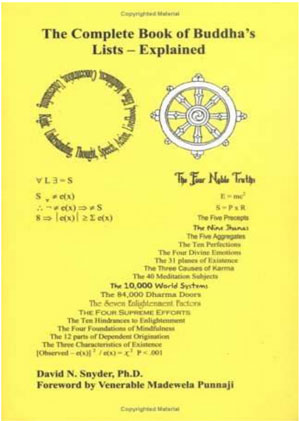
Beginning with “The Four Noble Truths”1, “The Noble Eightfold Path”2, and so on, the Buddha was a list-maker. I recently found a wonderful book, now out of print but freely available as a pdf. By David Snyder, Ph.D., it is called “The Complete Book of Buddha’s Lists - Explained”

Snyder does a brilliant job of reinterpreting these lists and framing them in the context of what the social sciences say about how we function individually and in groups.

I was particularly struck by his treatment of The Four Brahmavihārās, along with their near and far enemies.

Brahmavihārās Meaning Near enemy Far enemy
metta loving-kindness self-affection painful ill-will
karuna compassion pity cruelty
mudita sympathetic joy exuberance resentment
upekkha equanimity indifference craving, clinging

Whether the book is a useful introduction to Buddhist philosophy and practice would be a matter of debate; but for someone who understands its basic tenets, the book is outstanding.


  1. 1. It is in the nature of life to suffer. 2. Suffering is caused by desire. 3. Suffering ceases when we let go of desires. 4. There is a process for letting go of desires. Sometimes I think that the word “desire” is too loaded in English. I like David Snyder’s interpretation; he reframes it as “unreasonable expectations.” ↩︎

  2. As the name implies, eight practices of mind and being in the world that yield liberation from the suffering caused by desires. An article on the Noble Eightfold Path. ↩︎
Beginning to experiement with Stanza for natural language processing

After installing Stanza as dependency of UDAR which I recently described, I decided to play around with what is can do.

Installation

The installation is straightforward and is documented on the Stanza getting started page.

First,

sudo pip3 install stanza

Then install a model. For this example, I installed the Russian model:

#!/usr/local/bin/python3
import stanza
stanza.download('ru')

Usage

Part-of-speech (POS) and morphological analysis

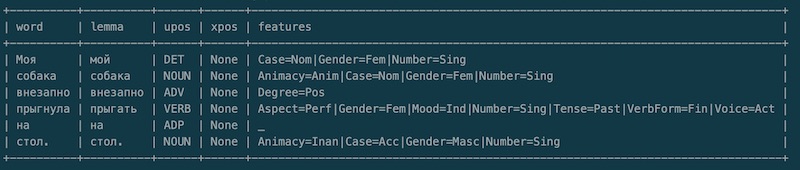
Here’s a quick example of POS analysis for Russian. I used PrettyTable to clean up the presentation, but it’s not strictly-speaking necessary.

#!/usr/local/bin/python3
import stanza
from prettytable import PrettyTable

tab = PrettyTable()
tab.field_names = ["word","lemma","upos","xpos","features"]
for field_name in tab.field_names:
    tab.align[field_name] = "l"

nlp = stanza.Pipeline(lang='ru', processors='tokenize,pos,lemma')
doc = nlp('Моя собака внезапно прыгнула на стол.')
for sent in doc.sentences:
    for word in sent.words:
       tab.add_row([word.text, word.lemma, word.upos,
       word.xpos, word.feats if word.feats else "_"])
print(tab)

Note that upos are the universal parts of speech where xpos are language-specific parts of speech.

Named-entity recognition

Stanza can also recognize named entities - persons, organizations, and locations in the text it analyzes:

import stanza
from prettytable import PrettyTable

tab = PrettyTable()
tab.field_names = ["Entity","Type"]
for field_name in tab.field_names:
	tab.align[field_name] = "l"

nlp = stanza.Pipeline(lang='ru', processors='tokenize,ner')
doc = nlp("Владимир Путин живёт в Москве и является Президентом России.")
for sent in doc.sentences:
	for ent in sent.ents:
		tab.add_row([ent.text, ent.type])
print(tab)

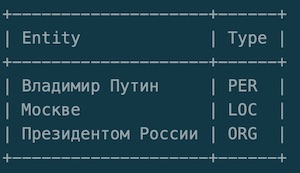
which, tells us:

I’m excited to see what can be built from this for language-learning purposes.