L-R method for language learning
I’ve recently discovered the L-R system of language learning and have been setting up to learn it.
The idea is that you begin with long texts - novels, for example - in your target language (L2) and follow a systematic approach to reading and listening.
L-R system in a nutshell
Here are the steps:
- Read the text in L1 (your native language) and become familiar with it.^[I rephrased this instruction from other sources that say “read the translation” because what if the text itself if a translation? For example, my first text to try this with is Гарри Поттер и философский камень which was originally written in English and then translated into Russian, among other languages. So, it’s best to say for the first step “Read the text in your L1 and become very very familiar with what it says.”]
- Listen to the recording and simultaneously read the text in L2.
- Listen to the recording while reading the text in L1.
- Repeat after the speaker. But only do this once you truly understand the meaning of what you’re repeating. The goal is meaning, not only pronunciation.
- Translate the text from L1 to L2 by covering up one side while reading the other.
Tips
It is hard, very hard in fact, to find parallel texts. Even if you can find .txt documents online, the formatting is a challenge. Columns in Word or Pages simply don’t work, because the L2 and L1 doesn’t line up properly. So here’s what I did for formatting Harry Potter and the Philosopher’s Stone^[Before you accuse me of intellectual property theft, I will mention that I own both the Russian translation and the English language original in book form. So no harm done to anyone.]:
- With the help of Internet search, I found:
- The Russian text of Гарри Поттер и философский камень .
- The English text
- The audiobook of Гарри Поттер и философский камень in Russian.
Formatting the L2 and L1 text
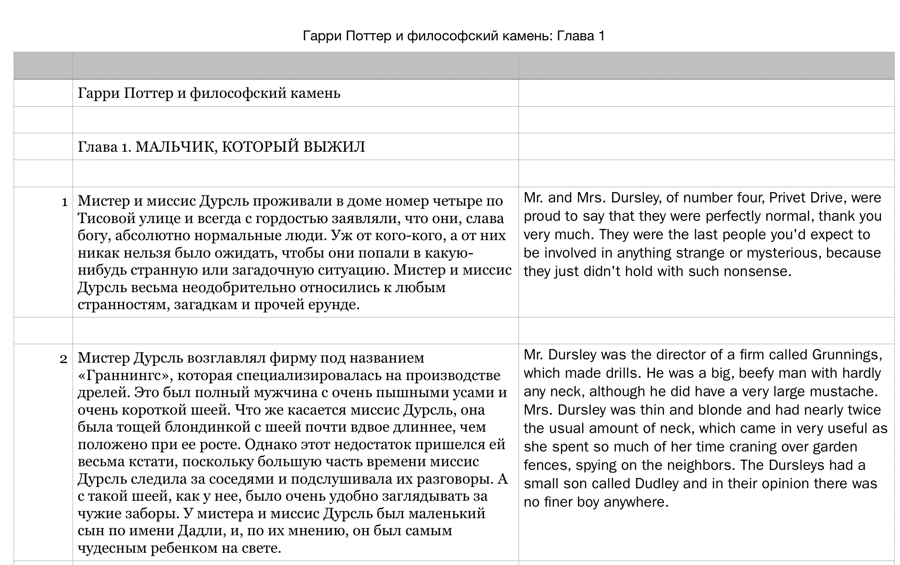
It turns out that a spreadsheet is the best way to organize the parallel texts because it has the ability to display it in columnar format while maintaining the correct vertical alignment by paragraph or section. After cleaning up the import to Numbers, I lined up the L1 with the L2, skipping a row between paragraphs. Then I turned my attention to the audio.
Downloading and processing the audio
This particular book was available on YouTube chapter-by-chapter. I used ClipGrab to download the audio from YouTube. With the audio file on my desktop, I used Audacity to chop it up into separate mp3 files. This is beyond the scope of this article, but the way to do it is to place markers at the beginning of each paragraph as displayed in your spreadsheet. After this is all done, you can export the audio as multiple mp3 files by marker. For my text, I ended up with a directory of 128 mp3 files and to make my life easier, I added a column for the track number for each paragraph in my spreadsheet.
That’s all I’ve got. I can’t yet tell you how beneficial it is. Hopeful.
References
- Here is a succinct summary of the method
- The original description of the method - a little hard to understand, but this is where the credit is due.