Politics

Scalia and the secret society

It was recently reported in the Washington Post that the late Supreme Court Associate Justice Antonin Scalia had ties to a secret society of hunters called the International Order of St. Hubertus and that several of the guests at the Texas ranch where Scalia died were members of this group.

Surely I’m not the only one that finds this a bit weird. A secret society of hunters? I don’t know the first thing about hunting but from I’ve seen, the only thing secret about hunting is sneaking up on an animal so you can kill it.

On the lack of association between taxes, GDP and happiness

During a February 6, 2016 debate, U.S. presidential aspirant Donald Trump claimed that: “Right now we’re the highest taxed country in the world.”

Well, living in a country with much higher tax rates, I can tell you that his statement is patently false.^[Maybe he’s referring to the corporate tax rate which is quite high; but even that is irrelevant to the fact that all sorts of deductions and exclusions on the U.S. corporate tax return put the U.S. effective tax rate much lower than that of most counties.]
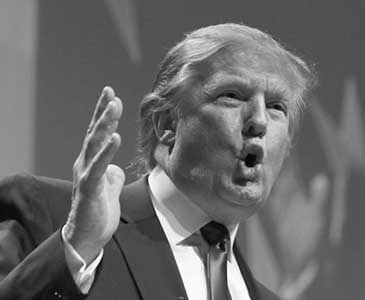
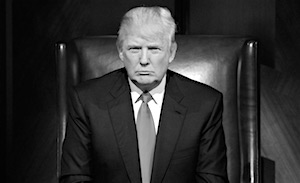
Trump meets computational linguistics

Trump orating

“I actually called her, and she never mentioned my name. You know, I - when I sold - oh, did I get a call from one of the Environmental Protection Agency, they couldn’t find it because it comes out in big globs, right, and you say to yourself, ‘How does that help us?’”

Trump is one of the most amusing orators in the history of presidential politics in the the U.S. But I wondered what would happen I took the text of a few of his speeches and fed it into a algorithm that uses Markov chains to shake things up a bit.

Leaving something and taking something away.

Trump

“Every person passing through this life will unknowingly leave something and take something away. Most of this “something” cannot be seen or heard or numbered or scientifically detected or counted. It’s what we leave in the minds of other people and what they leave in ours. Memory. The census doesn’t count it. Nothing counts without it.” - Robert Fulghum All I Really Need to Know I Learned in Kindergarten

The anti-polarizing effect of keeping one's identity small.

Keeping your identity small

Keeping your identity small

Several years ago, Paul Graham, of Y Combinator fame wrote an essay entitled “Keep your Identity Small.” The premise is that discussions of religion and politics almost never result in anything resembling the give-and-take around other subjects. Two people can have an intelligent conversation about the pros and cons of certain brands of rice cookers^[We happen to use a Zojirushi and like it a lot; but I’d never introduce myself as a Zojirushian.]; but if the discussion turns to religion or politics, it’s essentially over. Graham’s conclusion is that religion and politics both engage a person’s identity. Once a conversation turns to identity, it’s hard to separate issues from people^[The best-selling book “Getting to Yes” by Fisher and Ury on negotiation techniques touched on this issue with it’s first principle of “Separate the people from the problem.” Emotions are a source of real problems in negotiation because people respond with anger when their personal interests are at stake. By treating issues as entities separate from the people that involve them, holiding them, inspecting and debating them on their own terms, it becomes easier to have conversations about them.]

Properly understanding ISIS

Islamic weapons

An interesting piece from The Atlantic on understanding ISIS on their own clearly-stated terms.

“We have misunderstood the nature of the Islamic State in at least two ways. First, we tend to see jihadism as monolithic, and to apply the logic of al‑Qaeda to an organization that has decisively eclipsed it…Bin Laden viewed his terrorism as a prologue to a caliphate he did not expect to see in his lifetime. The Islamic State, by contrast, requires territory to remain legitimate, and a top-down structure to rule it.”

Private virtues v. public life

Politics is hopeless arena in which to enact individual values. Commercial interest will always win because of the enormous cost of modern politics. As I’ve written before1 I think that voting is an inefficient way of effecting change in a way that aligns with personal values. Persons can only be elected when they affiliate themselves with a package of values whose source is largely commercial interest. For example, if I placed the highest values on a balanced federal budget, low defense spending, universal health care, and inclusive rights, who would I vote for?

Commerce and discrimination

Those darned Republicans just can’t catch a break these days. In the latest cultural eruption, the Indiana legislature passed a bill which its governor signed into law. The bill allows places of business to refuse to serve persons if doing would conflict with their sincerely-held religious beliefs. An avalanche of public outcry has Indiana’s governor making a hasty retreat.

Charles Blow of the New York Times weighs in about how we should deal with the juxtaposition of free exercise of religious beliefs and discrimination: